
Your clients trust you with their most confidential information. But how secure is your law firm?
Imagine arriving at the office on Monday morning.
Your emails aren’t working. You can’t access client files. A property completion is due in two hours, and your practice management system is down.
Then you discover a cyber attack has hit your law firm.
For solicitors, this isn’t just an IT problem. It’s a client confidentiality problem, a business continuity problem and potentially a serious reputational problem.
Law firms handle sensitive information every day, from financial records and property transactions to divorce proceedings and confidential business agreements.
And cybercriminals know it.
That’s why every legal practice should consider Cyber Essentials certification.
But what is Cyber Essentials, do solicitors actually need it, and how can it help protect your practice?
What Is Cyber Essentials for Law Firms?
Cyber Essentials is a UK government-backed cyber security certification scheme designed to help businesses protect themselves against common cyber threats.
For law firms, Cyber Essentials provides a recognised framework to improve IT security and protect sensitive client information.
It focuses on five essential areas:.
- Firewalls: Helping prevent unauthorised access to your systems.
- Secure configuration: Making sure your devices and software are set up securely.
- Security updates: Keeping software up to date to address known vulnerabilities.
- User access control: Ensuring employees can only access what they need.
- Malware protection: Helping protect devices against malicious software.
Sounds straightforward, doesn’t it?
But when was the last time your law firm checked that every laptop was updated, former employees no longer had access to systems, and security settings were configured correctly?
These weaknesses can leave a legal practice exposed.
Cyber Essentials helps law firms identify and address them.
6 Reasons Why Law Firms Need Cyber Essentials Certification
1. Your Law Firm Is Sitting on Information Cybercriminals Want
Think about the information your solicitors access every day.
Client bank details. Contracts. Medical records. Financial settlements. Property transactions. Confidential emails.
Now imagine that information falling into the wrong hands.
Cybercriminals don’t just target multinational companies. Smaller solicitors’ practices can also be vulnerable, particularly if they lack dedicated IT security resources.
Cyber Essentials certification helps law firms implement fundamental security controls to reduce the risk of common cyber attacks.
Your firm doesn’t need to be big to be targeted.
2. One Cyber Attack Could Bring Your Practice to a Standstill
What would happen if your law firm couldn’t access its systems for an entire day?
Or worse, an entire week?
No client files. No emails. No access to case management software.
Meanwhile, your solicitors still have deadlines, clients still expect answers, and the bills don’t stop.
A cyber attack on a law firm can lead to:
- Disrupted legal work and missed deadlines.
- Loss of access to confidential client information.
- Financial losses and recovery costs.
- Potential data protection consequences.
- Damage to your firm’s reputation.
- Loss of client confidence.
Cyber Essentials doesn’t guarantee that an attack won’t happen, but it can help reduce exposure to many common threats.
Prevention is far better than explaining to a client that their confidential information may have been compromised.
3. Clients Expect Their Solicitors to Take Cyber Security Seriously
Would you trust a law firm that couldn’t explain how it protects your personal information?
Probably not.
Whether you’re handling a house purchase, a commercial contract or a family dispute, clients expect confidentiality.
And businesses increasingly want evidence that their suppliers and professional advisers take cyber security seriously.
Cyber Essentials certification gives your law firm a recognised way to demonstrate that it meets an established baseline of technical security controls.
It may also help when tendering for contracts or working with corporate clients that have supplier security requirements.
Good cyber security isn’t just about protecting your practice. It’s about protecting the trust you’ve worked hard to build.
4. Cyber Essentials Can Support Your Law Firm’s Compliance Responsibilities
Is Cyber Essentials mandatory for solicitors in the UK?
Generally, no. Cyber Essentials certification isn’t a blanket legal requirement for every UK law firm.
However, solicitors do have responsibilities to protect confidential client information.
Law firms must consider their obligations under UK GDPR, data protection legislation and relevant Solicitors Regulation Authority (SRA) requirements.
Cyber Essentials can help support these responsibilities by providing a practical framework for fundamental technical security measures.
Cyber Essentials certification doesn’t automatically make your law firm GDPR-compliant or meet every SRA requirement.
But it can form an important part of your wider law firm cyber security strategy.
5. A Single Fraudulent Email Could Cost Your Law Firm Thousands
Imagine a solicitor receives an email that appears to be from a client.
The name looks familiar. The conversation seems genuine. The email requests a change to bank details ahead of a property transaction.
But it isn’t from the client.
It’s a cybercriminal.
Email compromise, phishing attacks and payment diversion fraud are serious risks for law firms, particularly those handling large financial transactions.
Cyber Essentials helps reduce certain technical weaknesses that attackers exploit to compromise systems and accounts.
Combined with staff training, secure payment-verification procedures, and appropriate email security, it can strengthen protection.
Sometimes the biggest cybersecurity risk starts with an email that looks completely normal.
6. Cyber Essentials Could Give Your Law Firm a Competitive Advantage
Imagine two law firms competing for the same corporate client.
Both have experienced solicitors. Both offer similar services.
But one can demonstrate that it holds recognised Cyber Essentials certification.
For clients who take information security seriously, that additional reassurance could matter.
Cyber Essentials for solicitors isn’t just about ticking a compliance box.
It shows prospective clients that your practice takes protecting their information seriously.
And for firms looking to work with larger businesses or organisations with strict procurement requirements, certification may be particularly valuable.
Cyber Essentials vs Cyber Essentials Plus for Law Firms
Cyber Essentials has two levels.
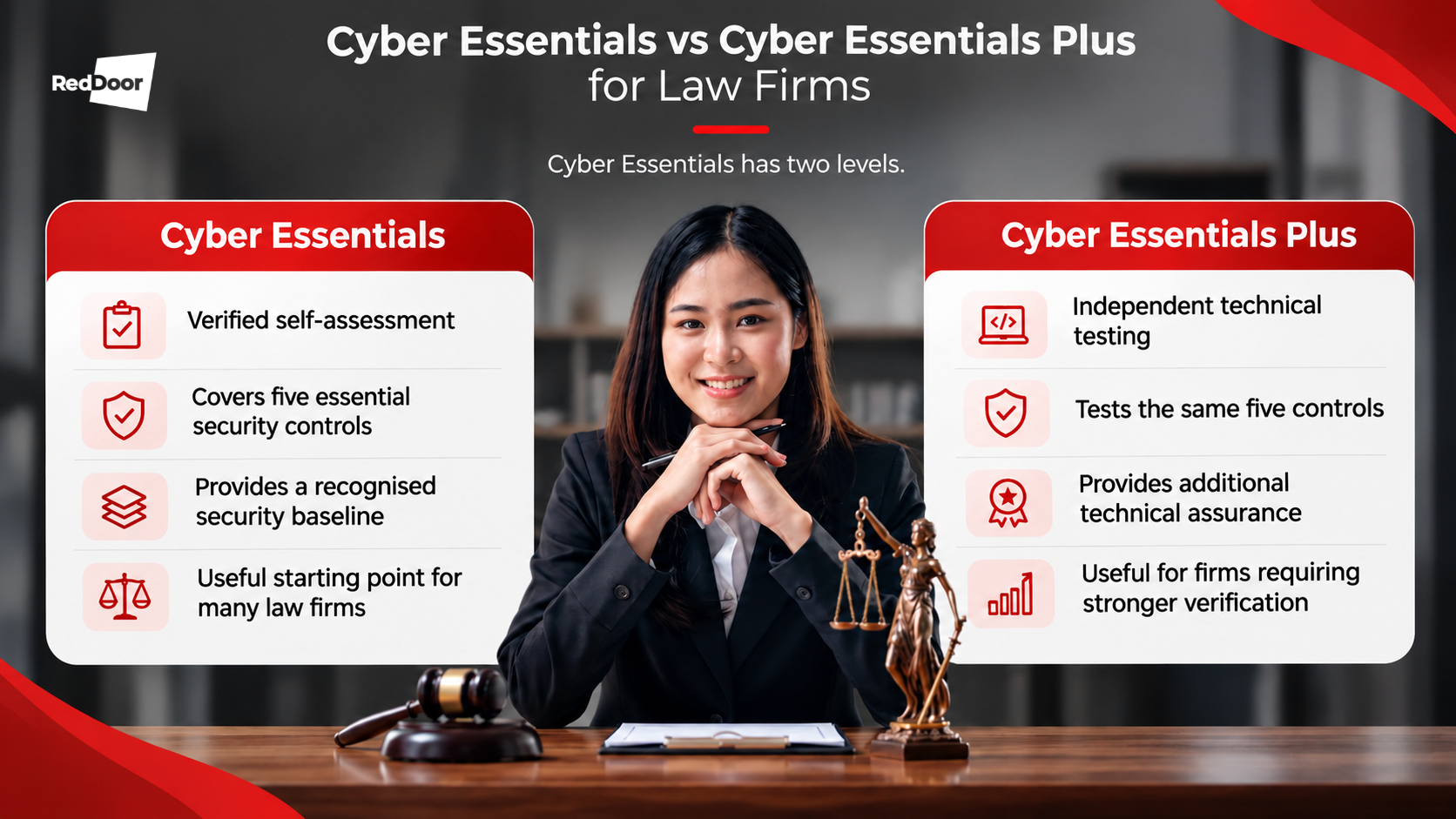
Cyber Essentials demonstrates that your law firm meets the scheme’s core technical security requirements through a verified self-assessment.
Cyber Essentials Plus goes a step further, with independent testing to verify those controls work effectively.
For law firms handling particularly sensitive information or working with clients who require additional security assurance, Cyber Essentials Plus may be worth considering.
How Much Does Cyber Essentials Cost for Solicitors?
The cost of Cyber Essentials certification depends on your law firm’s size.
Basic Cyber Essentials certification starts from £320 plus VAT, with higher fees for larger organisations. Current pricing should be confirmed when applying.
Cyber Essentials Plus pricing varies depending on your IT systems’ complexity and the required technical assessment.
You may also need to make improvements before certification, such as updating unsupported devices, strengthening access controls or improving security configurations.
But compare that investment with the potential disruption and costs of recovering from a cyber attack.
Cyber security shouldn’t become a priority only after something has gone wrong.
How Can Your Law Firm Get Cyber Essentials Certified?
Getting Cyber Essentials certification for your law firm involves five key steps:
- Review your current IT security. Understand which devices, systems and cloud services your practice uses.
- Assess the five Cyber Essentials controls. Identify whether your law firm meets the current technical requirements.
- Fix any security gaps. Address outdated software, insecure settings or inappropriate access permissions.
- Complete your Cyber Essentials assessment. Submit your verified self-assessment through the official certification process.
- Maintain your security standards. Continue reviewing your systems and renew your certification annually.
You don’t need to manage the entire process alone. An experienced IT and cyber security provider can help you understand the requirements and prepare your systems for assessment.
Is Cyber Essentials Enough to Protect Your Law Firm?
Cyber Essentials is an important starting point, but it isn’t a complete cyber security strategy.
Law firms should also consider:
- Multi-factor authentication.
- Secure data backups and recovery plans.
- Cybersecurity awareness training for employees.
- Phishing and email security.
- Monitoring for suspicious activity.
- Incident response and business continuity planning.
The aim isn’t simply to obtain a certificate.
It’s to build a law firm that’s better protected, better prepared and less vulnerable to disruption.
Need Help With Cyber Essentials for Your Law Firm?
At RedDoor IT, we help professional services businesses take a proactive approach to IT and cyber security.
Whether you’re looking to achieve Cyber Essentials certification, considering Cyber Essentials Plus or simply want to understand how secure your law firm really is, we’re here to help.
Or speak to the RedDoor IT team about Cyber Essentials certification for your law firm.
Don’t wait until something goes wrong to discover the gaps in your security.